Okay, I’m coming up for air.
Since we kicked off beta testing last fall, it has been a lot. Like, a lot a lot. We’ve been heads down — messaging with testers around the clock, hosting group Zoom calls, sending surveys, chasing down bugs, releasing feature improvements, and somehow doing all of that while continuing to build out major features. I’ve tried to share the behind-the-scenes as we go, but honestly? I’ve been a little too busy actually living it to always stop and document it.
So this post is my attempt to fully catch you up. We’ve come a long way since last fall, and I want to walk you through all of it — the things that went better than I could have hoped, the things that needed real work, and what we learned along the way.
First, a little context on how beta actually worked…
When I decided to run a beta program before publicly launching Tezzera, I made a deliberate choice to keep it small and controlled. Not because I lacked confidence in the platform. It was actually because I had too much confidence in it!
I knew from the very beginning that the design community was desperate for a new CRM option. From the moment I first shared my vision for Tezzera, I was constantly getting DMs and comments from other designers saying how they needed it to launch asap. So I didn't want to open the floodgates and get buried under more users than we could support well. For a small team, that's a fast way to end up with frustrated users and a product that can't keep up.
So we were intentional about it. Phase one welcomed around 30 hand-selected beta testers. Then phase two (what we called Beta 2.0) opened to our waitlist of just over 1,000 people in November. And since then, we've kept things gated, growing slowly, and staying focused on delivering really high-touch customer support while we work through the final pieces of development.
Now let’s get into the juicy stuff…
The Highs
Going into beta, I had three big hopes. Three problems I’d personally experienced with other CRMs that I was determined to solve with Tezzera, and that I desperately wanted our testers to confirm we were on the right track to solving.
The first was design.
Designers shouldn't have to use ugly tools. I know that sounds obvious, but most CRMs are cluttered, dated, or just visually exhausting to look at every day. I wanted Tezzera to feel calm, clean, and like something you'd actually want to open in the morning. Our visual design scored 4.61 out of 5 from first round of beta testers — the highest-rated feature across the whole platform. Words like 'beautiful,' 'minimal,' 'clean,' and 'grounding' came up again and again. So I think it’s safe to say that we nailed this part!
The second was the all-in-one problem.
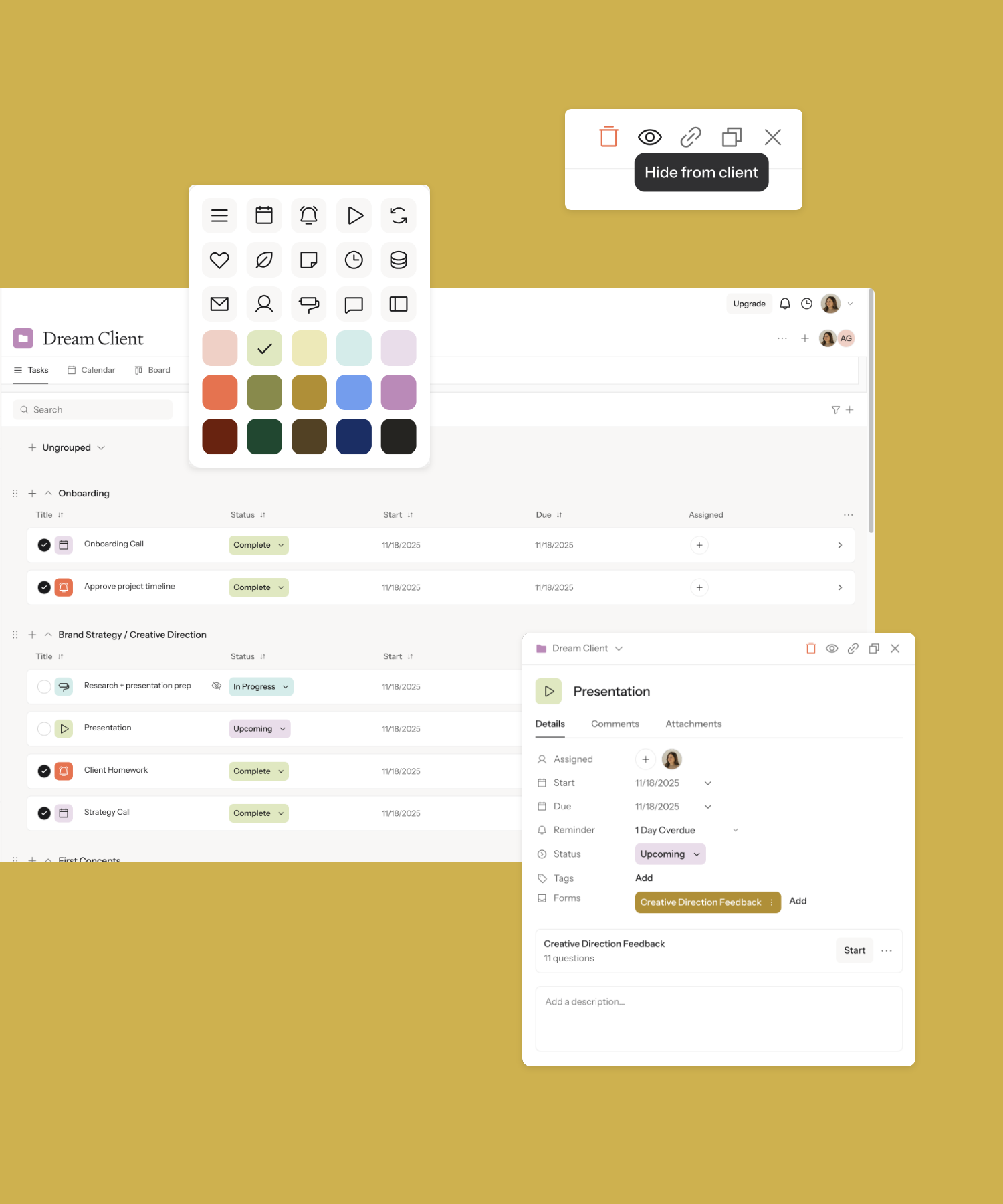
When I first started surveying designers about their current CRM setups, I wasn’t surprised to discover that many of them were paying for two, sometimes three separate platforms because they couldn't find one that handles both the client management side (contracts, invoices, forms) and the project management side (task timelines, client collaboration, feedback) without one of them being a compromise. I’d also experienced this personally. For 9 years of running my own design business, I had always paid for two separate platforms just to handle basic project management. So solving this problem was a core ambition for Tezzera from day one. Project management was the most mentioned favourite feature, and 'all-in-one solution' was cited by multiple testers specifically as something Tezzera does better than their current tools.
The third was customization.
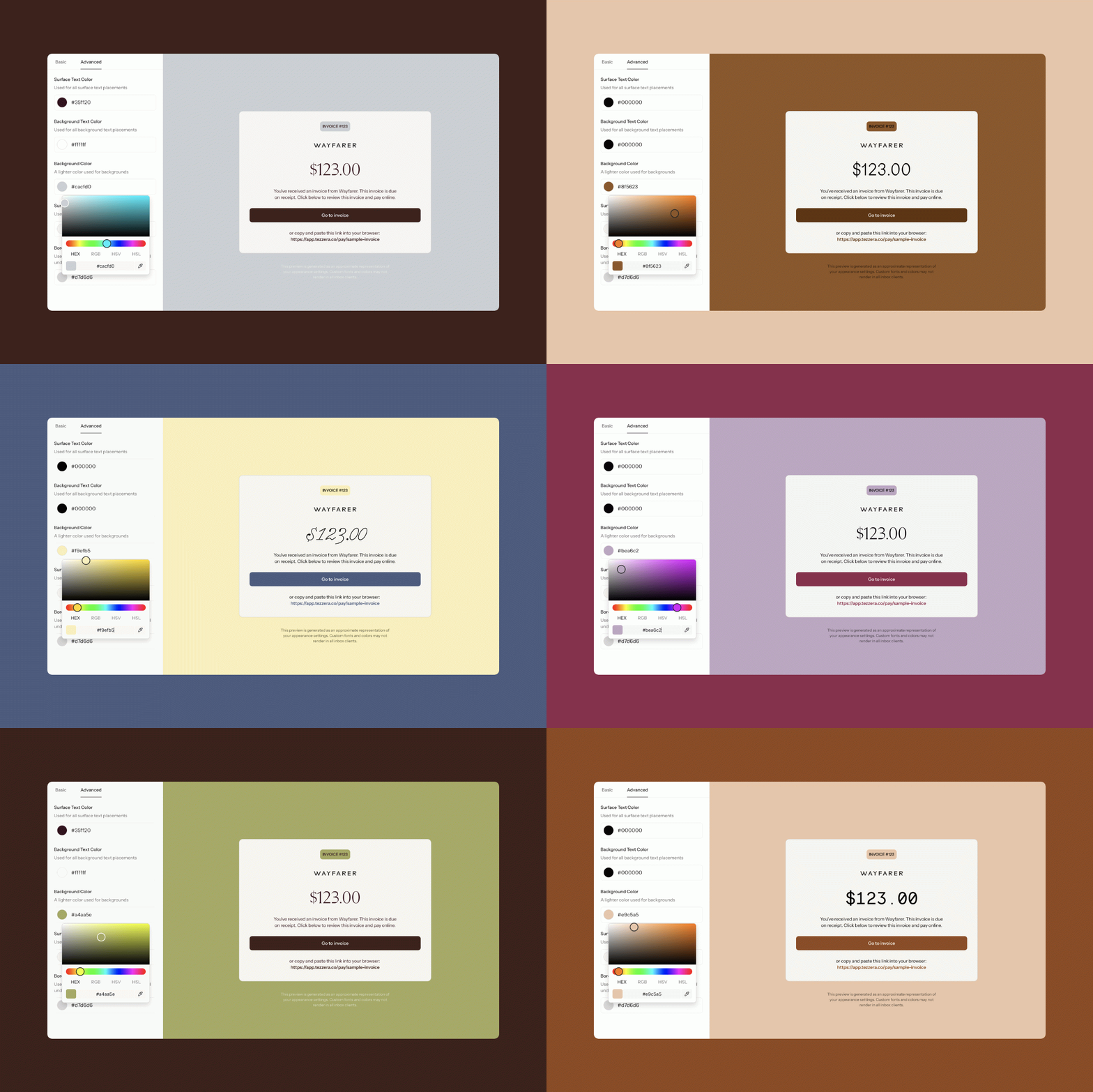
Designers want to make their tools their own, and most CRMs make that either extremely limiting or annoyingly technical, buried in custom CSS that nobody has time for. So we built in customization that designers can appreciate: custom fonts, colors, logo, all without touching a single line of code.
““I can upload my own fonts!?! I LOVE that so, so, so much. It’s sooooo wonderful to have an admin setup that is actually beautiful to use!””
By week one, 91% of testers had positive first impressions, 60% said they were likely or very likely to switch to Tezzera from their current tool after a single week, and 83% were at maximum motivation to keep testing. Honestly? I cried a little reading those numbers.
The Lows
Beta wasn't all glowing reviews. And I wouldn't want it to be! Because nothing is going to be perfect the first time around. And especially for a platform like this, you can’t really “perfect” anything until you people start to use it (and maybe break some things). 🙈 Here are the challenges that kept us busy behind the scenes.
Rebuilding the contract editor from scratch.
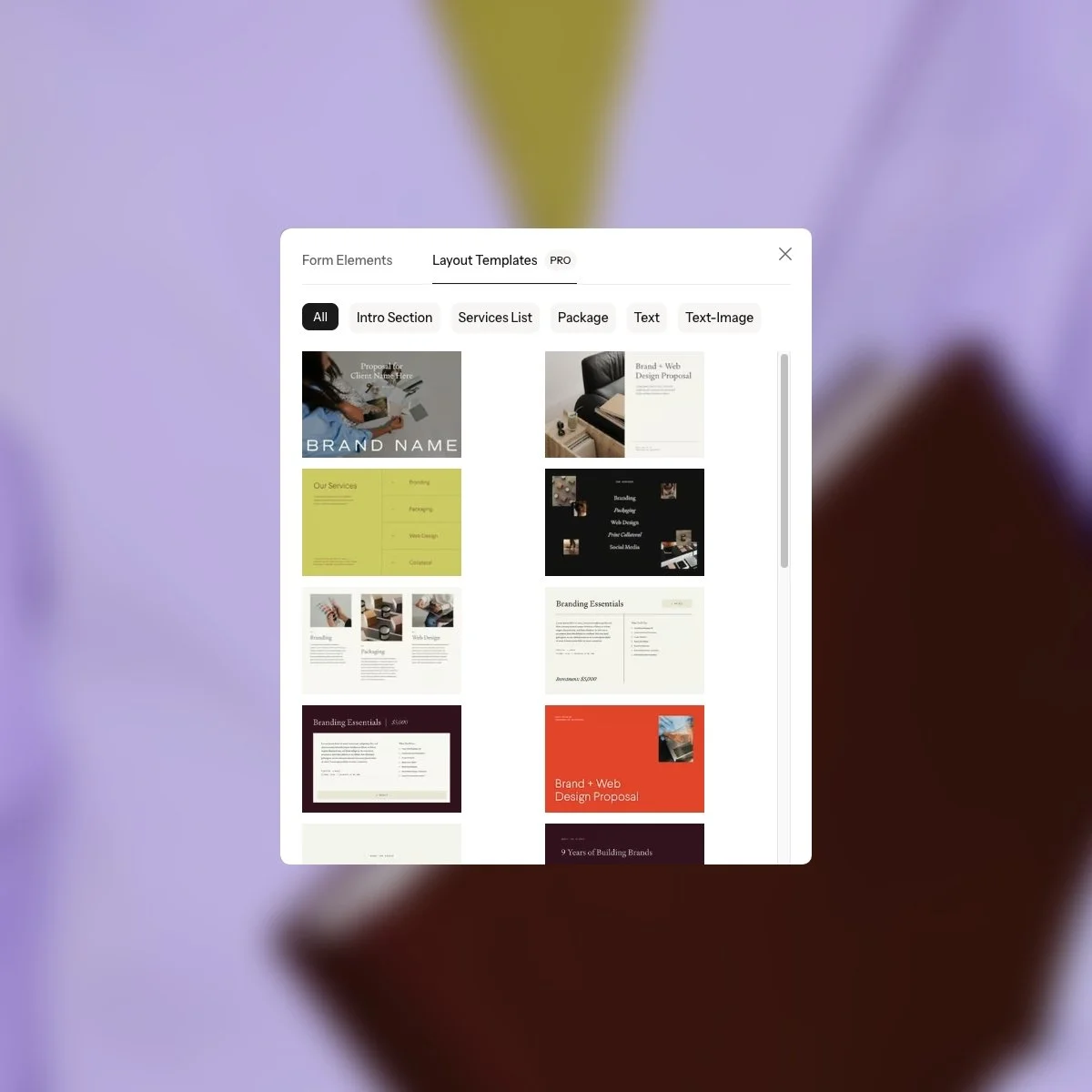
Our developers had a vision for approaching the contract editor differently than other CRMs do, and honestly, I was here for it! But once real designers started using it, it became clear pretty quickly that the approach wasn't working the way we'd hoped. So instead of just tweaking it, we scrapped it and rebuilt the whole thing. That's not the fast option, but it was the right one, and I'm genuinely proud of what the new editor looks like. (More on that very soon.)Making our customizable form layouts fully responsive.
This one was genuinely tricky. Tezzera lets you build beautiful, on-brand forms without touching a single line of code, which is a feature I'm really proud of. But getting those custom layouts to look great across every screen size? That took some serious work. We knew we couldn't ask designers to choose between a form that looks amazing and a form that works on mobile. It had to be both, so we kept at it until it was.Figuring out what's actually a bug vs. what's user error.
Of course there are going to be bugs on a new platform. That's the entire point of beta. But what nobody tells you is that sometimes what looks like a bug is actually a typo in an email address or someone forgetting to click a button. Tracking down the actual root cause can be dizzying. That said, even the "user error" situations teach us something. Sometimes it's a UX issue that needs to be more intuitive. Sometimes it's a gap in our tutorial library. Either way, we take notes and we fix it.Managing customer support across timezones while also being a mom and running a design business. This has honestly been the hardest part for me personally. On Beta 2.0 launch day, I was answering chat support messages for something like eight hours straight, helping people get their accounts set up, making sure everyone had the right coupon codes, just making sure nobody fell through the cracks. It was a lot. And to this day, I'm often the one on the other end of your support requests, which can be a lot to juggle alongside client work and life with a toddler.
But weirdly, it's also been one of my favorite parts of this whole journey. When someone sends in a question expecting a bot and I pop in to help them, and they respond with "Oh my gosh, hi Abbey!!" — it makes my day every time. It doesn't feel like customer support. It feels like chatting with a friend. And that's the kind of community I feel so lucky to have built with Tezzera.
The Lessons
If I could go back and say one thing to myself at the start of all this, it would be: it's going to be hard, but it'll be worth it. Keep going. People believe in what you're building, and they'll understand if it takes time to get it right.
And it turns out, that’s true. Our community has been extraordinary. Not just in their patience, but in the quality of their feedback. They filed bug reports, attended office hours, sent detailed survey responses, and showed up week after week. They didn’t just test Tezzera. They helped build it.
A few things I know now that I didn't fully appreciate before:
Slow, intentional growth is a feature, not a limitation.
When you can actually respond to every support message, implement feedback in real time, and know your users by name, that’s not a small-team constraint. That’s a competitive advantage.
Being your own customer changes everything.
The features our community gets most excited about are the features I've been waiting for too. That alignment means we're building something real, not something we think people want.
Honest feedback is a gift.
The testers who told us the contract editor wasn’t ready? Those were the most valuable responses we received. Not the kind words, though those were wonderful too. The honest ones. The “this doesn’t work yet” ones. Those made Tezzera better.
Where We Go from Here
The highly anticipated proposal builder is nearly ready. The platform is more stable than it's ever been, and we're in the final stretch of testing before we open things back up.
When we do, it won’t be a grand launch announcement or a marketing blitz. It’ll be an invitation to the people who’ve been waiting, to the designers who tried it early and stepped back, and to everyone who’s been quietly watching and wondering if this might finally be the CRM built for them.
I think it is. I've always thought so. But I'm glad we took the time to prove it.
More coming soon. ❤️